


Warehouse automation has emerged as a major strategic lever for logistics players. Driven by the boom in e-commerce, growing customer expectations, and constant pressure on operational costs, many companies are taking the plunge. But before getting started, one key question arises: what budget should you plan for automating your warehouse? The answer depends on numerous parameters, and that is precisely what we will explore in this guide.
The challenges of logistics competitiveness
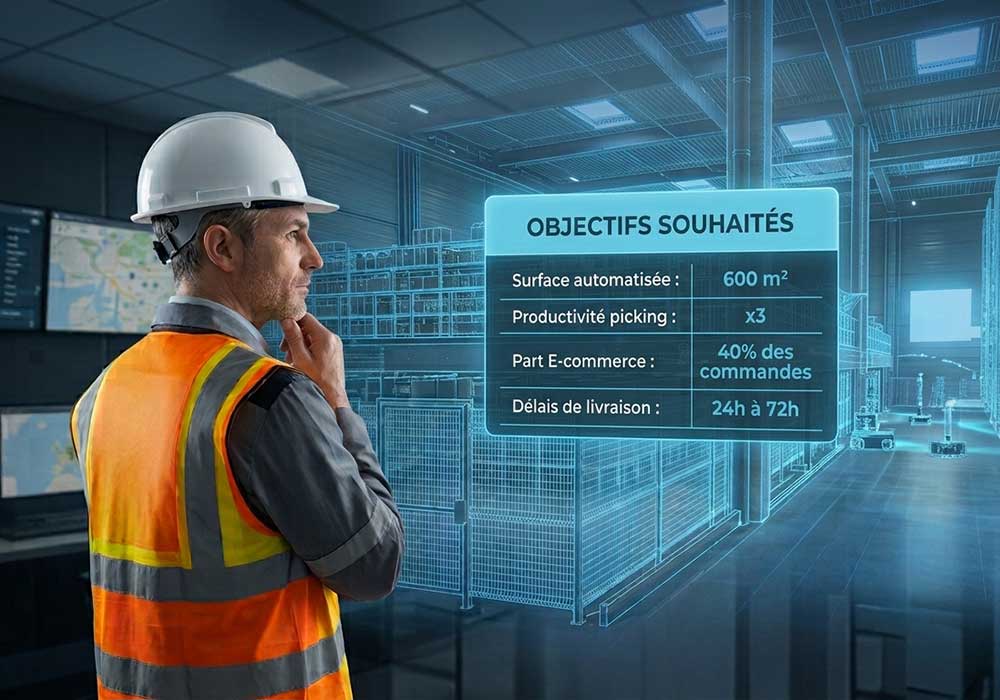
Logistics is at the core of company performance. Delivery times are shrinking, order volumes are rising, and picking errors are costly—both financially and in terms of customer satisfaction. In this context, automating your warehouse is no longer a luxury reserved for large corporations, but a necessity to stay in the race. Companies that fail to invest in modernizing their logistics tools risk being overtaken by more agile competitors capable of processing more orders with fewer errors and in shorter lead times.
The concrete benefits of automation
Automating a warehouse offers measurable and lasting benefits:
- Sharply increased productivity, reaching up to three times manual performance in certain cases.
- A reduction in order picking errors.
- Better storage space utilization thanks to optimized storage solutions.
- Reduced physical strain for operators, positively impacting workplace safety.
- The capacity to absorb peak activity periods without massive hiring.
These benefits fully justify the investment, provided that associated costs are properly anticipated.
Main cost items for automating your warehouse
Before pricing a project, it is essential to identify the various components that make up the overall warehouse automation budget.
Robotic and mechanical equipment
This is generally the largest cost item. It includes Autonomous Mobile Robots (AMRs), conveyor systems, robotic arms, automated sorting systems, and automated storage solutions like Goods-to-Person systems. The cost of this equipment varies considerably according to sophistication and volume. As an indication, an autonomous mobile robot costs between €20,000 and €80,000 to purchase, depending on its capabilities and embedded technology.
Management software (WMS, WCS)
Physical automation must rely on a high-performing software layer. The Warehouse Management System (WMS) steers goods flows, while the Warehouse Control System (WCS) coordinates automated equipment. These solutions represent a significant investment, often ranging from €30,000 to several hundred thousand euros depending on project complexity.
Integration and technical deployment
Implementing an automated system involves substantial integration work: physical installation of equipment, software setup, connection to existing systems (ERP, TMS, etc.), and validation testing. This item can represent between 15% and 30% of the total budget.
Team training
Automation transforms warehouse jobs. Operators must be trained to use new tools, supervise robots, and manage incidents. Allocating a training budget is essential to ensure deployment success and maximize ROI.
Maintenance and support
Once the system is live, recurring costs come into play: preventive and corrective maintenance contracts, software updates, and replacement of worn parts. These annual charges typically represent between 5% and 15% of the value of installed equipment.
What budget should you plan for automating your warehouse based on company size?
The budget varies considerably depending on company size and project ambition. Here is an estimate by profile.
Small and medium-sized enterprises (SMEs)
For an SME looking to partially automate its warehouse—for instance, by deploying a few autonomous mobile robots paired with management software—the budget generally ranges between €200,000 and €400,000. Modular and scalable solutions allow companies to start with a limited investment and expand the system progressively.
Mid-sized warehouses
For a mid-sized facility processing several thousand orders per day, a full automation project represents an investment of between €400,000 and €1 million. This budget typically includes a fleet of robots, a robust WMS, full integration, and staff training.
Large logistics facilities
Major logistics operators or industrial players with high-volume sites can invest several millions or tens of millions of euros in large-scale projects. These sites involve complex conveyor systems, fully automated warehouses, and robust IT infrastructure.
Factors influencing warehouse automation costs
Target level of automation
There are several levels of automation, ranging from simple robotic assistance to fully autonomous warehouses. The higher the level, the greater the initial investment—and the more significant the long-term productivity gains.
Nature of stored and handled products
Heavy, fragile, irregularly shaped products, or those subject to regulatory constraints (food, pharmaceuticals), require specialized and often costlier equipment. The diversity of SKUs managed in the warehouse is also a determining factor.
Condition and layout of the existing warehouse
A recent warehouse with flat floors and sufficient clear height will be easier and less expensive to automate than an older building requiring adaptation work. Aisle layout, suitable loading docks, and available power supply are all parameters to incorporate from the start. Read our cost breakdown comparison for building and automating a multi-level warehouse.
Choice of provider and technology
The logistics automation market offers a wide range of solutions and providers. Proprietary technologies may deliver superior performance, but at a higher cost. Comparing multiple offers and prioritizing interoperable solutions remains the best way to avoid technology lock-in.
How to finance your warehouse automation?
Available public aid and subsidies
In France, several schemes can help finance industrial and logistics automation projects. The France 2030 plan, Bpifrance support, regional subsidies, or innovation tax credits can significantly lower the bill. Consulting a specialized advisor helps identify the funding schemes your project is eligible for.
Leasing and modular financing solutions
Rather than tying up significant capital, many companies opt for leasing or long-term rental of robotic equipment. This approach spreads costs over time, preserves cash flow, and keeps equipment technologically up to date.
The Robot as a Service (RaaS) model
The RaaS model is an increasingly popular alternative, especially for SMEs. It involves paying for robot usage per task or via a monthly subscription, without a heavy upfront investment. This model offers great flexibility and allows companies to test automation before committing to a larger project.
How to calculate the return on investment (ROI) of automation?
Key performance indicators to track
To evaluate the profitability of an automation project, several key metrics should be monitored closely:
-
Cost per picked order, before and after automation.
-
Picking error rate.
-
Productivity per operator (number of lines processed per hour).
-
Equipment uptime rate.
-
Savings achieved on labor costs and overtime.
-
Order picking cost reduction levers identified and implemented (process optimization, targeted automation, travel reduction, etc.).
A concrete ROI calculation example
Consider a warehouse processing 1,000 orders per day with a team of 20 pickers. After partial automation via a Goods-to-Person solution, the operator productivity gain is immediate: productivity doubles, allowing the same volume to be handled with only 10 operators.
Assuming an annual operator cost of €35,000 including employer contributions, annual savings reach €350,000. With maximum flow optimization and error reduction, ROI can be achieved in under 2 years, ensuring fast and sustainable profitability.
Pitfalls to avoid when budgeting your automation project
Underestimating hidden costs
Many companies focus solely on equipment costs and overlook secondary expenses: building retrofits, integration, training, change management, or operational disruptions during deployment. A rigorous budget should include a safety margin of at least 10% to 20% for contingencies.
Neglecting the preliminary consulting and audit phase
Investing in a preliminary logistics audit is an indispensable step. It identifies priority flows to optimize, ensures correct solution sizing, and prevents over- or under-engineering the project. Its cost is widely offset by savings generated through a better-calibrated project.
SCALLOG, your partner for controlled and budgeted automation
A modular and scalable approach
SCALLOG provides logistics automation solutions leveraging autonomous mobile robots and dynamic storage. Thanks to a modular approach, every company—regardless of size—can start within its means and scale its installation alongside growth. This ensures maximum flexibility while maintaining full control over your budget.
End-to-end support
From initial audit to production launch, SCALLOG supports you at every stage: technical integration, team training, and project monitoring. This comprehensive approach guarantees a controlled deployment, adherence to deadlines and budget, and optimized return on investment. Discover our solutions and request a personalized quote for your warehouse automation.


Laisser nous votre commentaire