


The best warehouse automation suppliers are not those offering standalone technology, but those who understand your supply chain, your goods flows, and your operational constraints. The right choice should improve efficiency, safeguard warehouse availability, and enable gradual automation without disrupting operations.
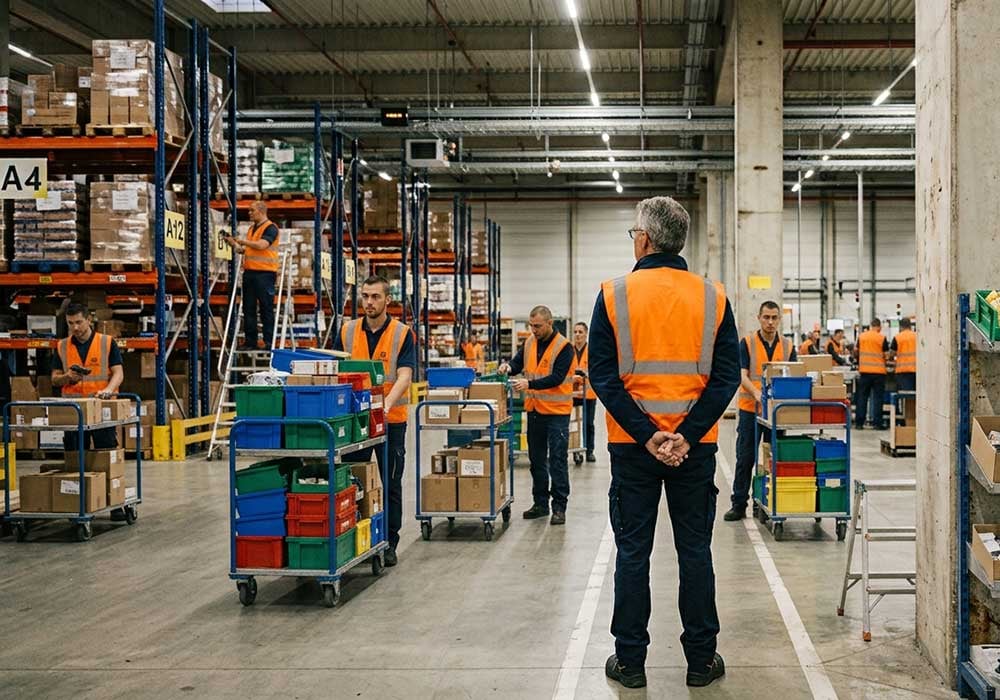
Comparing Suppliers on Operational Criteria
A reliable supplier starts with a site study. This step evaluates the building, processes, volumes, SKUs, safety constraints, and existing material handling equipment. It helps identify the type of automated system truly suited to daily operations, rather than picking a solution straight from a catalog.
Your logistics manager should request an analysis of goods flows, picking, order preparation, and peak periods. The supplier must also explain how to integrate systems with your WMS, warehouse control software, and management solutions. Without this digital continuity, robots and automated systems risk moving goods around without delivering lasting performance gains.
Service quality matters just as much as technology. Spare parts availability, technical support, training, maintenance, and the ability to scale the installation dictate operational continuity. A system can look great on paper, but prove difficult to operate if your teams lack the right support.
Key Technology Families to Consider
The choice depends on the type of flow, the nature of the goods, and the desired fulfillment method. Automation technologies notably include conveyors, automated storage and retrieval systems (AS/RS), autonomous mobile robots (AMRs), and goods-to-person solutions. These systems can automate transport, storage, replenishment, or picking, with varying levels of building integration.
Robots are particularly well-suited to repetitive moves between storage areas and workstations. Conveyors can maintain a continuous flow of goods in stable environments. Fixed systems offer automated organization and dedicated throughput capacity tailored to specific industrial or distribution processes. No single technology type addresses all operational needs on its own.
An automated warehouse can therefore combine several automated and robotic systems. The challenge lies in automating the right process, in the right place, with capacity aligned with expected growth. This approach avoids unnecessarily replacing existing equipment that remains effective.
Mistakes to Avoid When Selecting a Supplier
Neglecting the Site Study
An installation may require civil engineering, floor anchoring, utility adjustments, or traffic layout changes. These constraints must be identified before signing off. A detailed site visit sometimes reveals that floor conditions, clear height, or safety zones limit the types of systems that can be installed.
The supplier should outline the work required, its sequencing, and its operational impact. Fixed systems are not inherently bad options, but their installation can demand heavier preparation. The project’s goal is to evaluate these consequences and keep them under control.
Choosing Technology Without Evaluating Service
A robotic or conveyor solution is more than just hardware. You need to understand its control software, maintenance requirements, interfaces, and ability to handle exceptions. Real-world operations involve stockouts, non-standard items, and shifting priorities.
Ask how the supplier handles traceability, safety, and uptime. Running a workshop with operational teams allows you to test usage scenarios and ensure the automation remains intuitive for operators.
Automating Flawed Processes
Automating an unstable process only accelerates errors. Before automating, map out flows, waiting times, reworks, and quality checks. This analysis helps eliminate unnecessary movements and boost productivity without forcing excessive transformation.
Picking deserves special attention. Order profiles, SKU velocity, and preparation methods directly drive system sizing. Effective automation can speed up work, but it cannot replace clear storage and replenishment rules.
Underestimating Capacity and Peak Demand
System sizing must factor in average throughput, peak spikes, returns, and inventory variations. Underdimensioned capacity slows down operations, while overdimensioned capacity increases costs and complicates the setup. Peak simulations help verify how systems perform under stress.
The supplier must explain how they handle demand spikes, breakdowns, or partial outages. Modular solutions allow you to add robots, workstations, or zones without redesigning the entire warehouse—a flexibility that supports a smooth transition.
Overlooking Safety and Business Continuity
Safety encompasses people, robots, goods, and traffic routes. It must be built in from the design stage, featuring access controls, protected zones, and clear work procedures. The supplier should also outline fallbacks and degraded operational modes.
Certain automated systems require a concentrated installation period, particularly when civil engineering, floor anchoring, or structural modifications are involved. Other projects can rely on phased rollouts by zone, installation during off-peak hours, and a gradual cutover. The best approach depends on your facility and operations, not a simplistic debate between competing tech.
Maintaining Operations During Installation
Continuity relies on a detailed timeline. Phasing the deployment by zone makes it possible to work on one part of the warehouse while keeping other goods flows running. An initial zone can be installed, tested, and integrated with the WMS before extending the system further.
This method mitigates downtime risks and allows operational teams to learn gradually. It also simplifies performance tracking, as each step provides tangible feedback on capacity, uptime, and system efficiency.
A gradual cutover should include rollback plans, interface testing, and a period of parallel operation where necessary. Operations continue running smoothly while robots, conveyors, or other systems are brought online.
Evaluating Performance and Return on Investment
ROI goes beyond the initial purchase price. You must account for upfront investment, installation costs, maintenance, power consumption, training, and building modifications. Potential gains include improved productivity, reduced travel times, better picking accuracy, added capacity, and workplace safety.
To calculate the ROI of an automation solution, define key indicators before starting the project: cycle times, error rates, throughput per zone, equipment uptime, and floor space utilization. Quantifiable gains make for a far stronger business case than generic promises.
Optimize scope rather than trying to automate the entire facility at once. A high-throughput picking area is an ideal starting project. This phased approach allows you to drive immediate efficiency, validate assumptions, and adjust your plan based on actual results.
Selection Criteria Summary Table
| Criterion | Question to Ask the Supplier | Warehouse Benefit |
|---|---|---|
| Technologies | Which type of robots, conveyors, or systems best match our throughput? | Ensures a solution aligned with your inventory and picking requirements. |
| Integration | How will the system integrate with our WMS and existing control systems? | Guarantees traceability and operational continuity. |
| Capacity | How are peak demands and future volume growth managed? | Preserves availability, scalability, and long-term performance. |
| Installation | What civil engineering, phased rollouts, or floor anchoring are required? | Minimizes operational disruptions during site setup. |
| Service | What maintenance, training, and support services are included? | Sustains system efficiency and uptime over time. |
| Economics | What are the total costs, and which KPIs should be tracked post-launch? | Delivers a verifiable ROI based on real operational data. |



Laisser nous votre commentaire