


In a BANI world—brittle, anxious, non-linear, and unpredictable—supply chains face ever more frequent and sudden shocks. Given this paradigm shift, warehouse optimization can no longer be just about cutting costs and driving productivity.
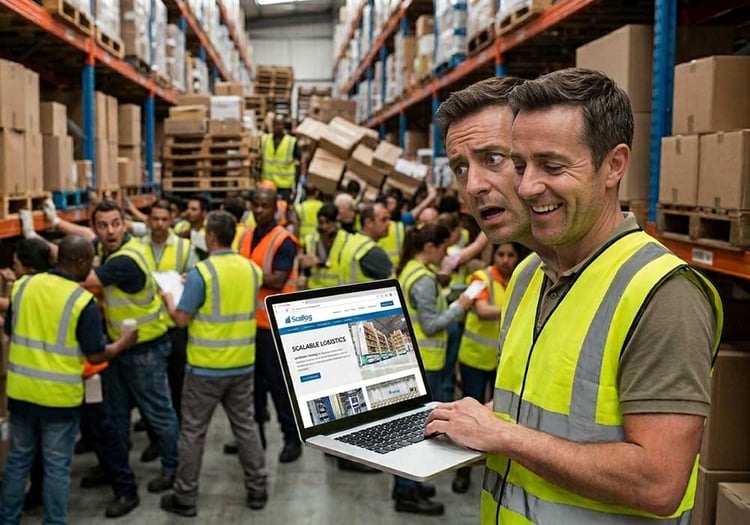
For three decades, companies have learned to navigate a VUCA world, marked by volatility, uncertainty, complexity, and ambiguity. Today, they have to deal with a more demanding reality, the BANI world, fragile, anxiety-provoking, non-linear and profoundly unpredictable. Ruptures are more abrupt, balances more precarious and changes more difficult to anticipate. Supply chains can be disrupted and reconfigured in a matter of days or even weeks as a result of customs decisions, new regulations or ever-increasing geopolitical tensions. This reality is not theoretical. According to the latest McKinsey survey, nine out of ten supply chain leaders faced supply chain disruptions in 2024. For logistics directors and managers, this paradigm shift does not call into question the fundamentals of logistics performance. It redefines the criteria. Warehouse optimization can no longer be based solely on the search for productivity and cost control. It must now integrate a new requirement: the ability to adapt quickly to an environment that has become unpredictable.
From optimization to continuous adaptation of warehouses
For decades, logistics performance has been built around one major objective: optimization. Optimizing space, processes, resources, and costs improved efficiency in a relatively predictable environment, where variations in activity remained within known ranges. The BANI world is shaking up this logic and is already reflected in companies' decisions. According to Gartner, nearly three-quarters of companies have changed their logistics network in the last two years, now prioritizing resilience, agility and flexibility over just the pursuit of the lowest costs. Variations in activity become more abrupt, sometimes without any warning signals. A customs duty introduced in a few days can redesign a sourcing strategy. A regulatory decision, a climatic episode, an exceptional order or a buzz on social networks can, in a few hours, disrupt logistics flows and put warehouses under pressure. Optimization is no longer just about looking for the best productivity or the lowest cost. Today, it is a question of preserving the efficiency of operations in the face of the unpredictable in the long term. Warehouses must now integrate a capacity for continuous adaptation, without calling into question their organization or processes. This evolution leads to a preference for scalable solutions, capable of supporting changes in activity rather than infrastructures that are fixed from the outset.
New Performance Benchmarks: Scalability, Responsiveness, and Resiliency
The criteria for optimising warehouses are evolving. Productivity, cost control and quality of service remain fundamentals, but they are no longer enough to guarantee a high level of efficiency over time. From now on, a high-performance warehouse is also a warehouse capable of quickly increasing its preparation capacity during a peak in activity, integrating new references or new flows without interrupting its operation, or reorganizing its operations to respond to a change in market or a supply disruption. Scalability, responsiveness and resiliency are thus becoming new performance criteria. The goal is no longer just to optimize the warehouse to meet today's needs, but to give it the ability to quickly absorb fluctuations in activity and market shocks, without compromising its quality of service and operational efficiency.
Technologies for warehouse agility
Meeting the new requirements of the BANI world requires technologies that can evolve at the same pace as warehouses. Scalable logistics robotics, such as SCALLOG's goods-to-person solution, meets precisely this requirement. By adding robots, picking stations or mobile shelves in just a few days, it supports business transformations rather than imposing a fixed configuration. However, this scalability must be based on solutions that are simple to deploy, intuitive to use and easy to scale. Software intelligence orchestrates flows in real time, optimizes robot movements and gives logistics managers a precise view of their business. Artificial intelligence, on the other hand, is constantly improving efficiency by anticipating variations in activity and refining operational decisions. This allows teams to make the right decisions more quickly in the face of unforeseen events. Technology is no longer intended to add complexity. On the contrary, it must make itself invisible so that the teams can devote themselves to their real added value: managing operations, absorbing hazards and guaranteeing the quality of service.
In a BANI world, sustainable performance is no longer measured solely by productivity. It is also based on the warehouses' ability to adapt quickly to hazards, while preserving the quality of service. In this context, technological sovereignty also becomes a factor of resilience. Designing, developing and maintaining solutions in France and Europe means offering companies greater control over their robotics and AI technologies, their data, their cybersecurity and the evolution of their tools over time. Faced with these new rules of the game, the real strength of a warehouse will no longer lie in its ability to predict the unpredictable, but in its ability to adapt to it.



Laisser nous votre commentaire