


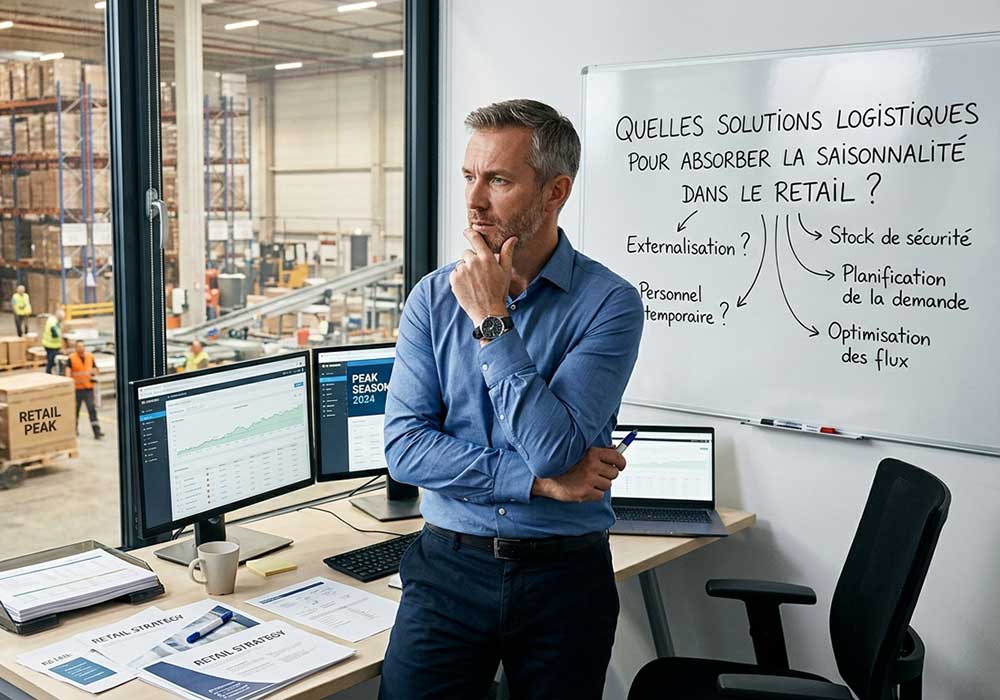
Managing seasonality in retail is a delicate balancing act. Insufficient preparation leads to stockouts and customer disappointment, while over-preparation results in storage costs and unsold inventory. The key lies not in a single solution, but in an agile combination of several logistical levers. To effectively absorb activity peaks, retail companies can rely on four pillars: flexible storage, temporary staffing, fine-tuned demand forecasting, and scalable automation.
Why Seasonality is a Major Logistics Challenge in Retail
Retail logistics is shaped by well-defined consumption peaks: sales, Black Friday, end-of-year holidays, and back-to-school periods. Although predictable, these periods represent a real logistical challenge, further heightened by the rise of omnichannel retail. Indeed, the proliferation of sales channels (brick-and-mortar stores, e-commerce, click & collect, marketplaces) complicates order flow management and demands unprecedented agility. During these peak periods, the sudden and massive spike in orders over a very short time frame places the entire supply chain under pressure, from the warehouse to retail stores and the last mile.
The main risk is twofold. On one side, stockouts result in an immediate loss of revenue and long-term damage to the customer experience. On the other side, overstocking ties up working capital, increases holding costs (insurance, space, security), and can lead to significant inventory depreciation. The challenge is to build a logistics organization capable of adapting to these volume variations without sacrificing profitability or service quality.
In this context, the robotic solution to the omnichannel challenge proves particularly relevant. Thanks to intelligent automation, it becomes possible to manage multiple flows simultaneously, optimize storage and order fulfillment, and react in real time to demand fluctuations. Robots bring flexibility, speed, and precision, enabling retailers to meet customer expectations effectively across all sales channels while controlling costs and securing their supply chain.
What are the Main Levers to Absorb Peak Demand?
To address these constraints, logistics managers can leverage several complementary solutions. The goal is to temporarily gain flexibility and capacity without permanently over-scaling infrastructure and teams. Among these solutions, managing peak activity with a robotic solution allows automated execution of specific tasks during high-demand periods, offering an efficient and scalable response to operational fluctuations.
Flexible and Temporary Storage
When the primary warehouse reaches capacity, the first option is to outsource part of the storage. Several models exist, such as short-term commercial leases or partnering with third-party logistics providers (3PLs) that pool warehouse space across multiple clients.
This solution enables companies to position buffer inventory closer to high-demand areas, thereby optimizing transport and delivery times. The growth of urban logistics has also introduced micro-fulfillment solutions, featuring urban mini-warehouses or leveraging retail store backrooms as forward stocking locations (ship-from-store) for the entire distribution network.
Temporary Staffing
To increase order picking throughput, scaling up the operational team remains a widely adopted solution in logistics. Relying on temporary staffing agency workers or short-term contracts allows operations to rapidly adjust workforce levels based on workload.
The main challenge with this approach lies in rapidly onboarding new workers while maintaining high quality and productivity levels. Efficient workstation layout and rigorous time management are essential to ensure the success of this temporary workforce and protect operational performance. However, there are also non-staffing levers to handle peak order volumes, such as automation, process optimization, and technological solutions. These alternatives allow businesses to absorb peak order volumes without additional hiring and achieve sustainable productivity goals.
Demand Forecasting via WMS and ERP Systems
Anticipation is key. Managing seasonal peaks effectively begins long before peak season arrives. Warehouse Management Systems (WMS) and Enterprise Resource Planning (ERP) software are valuable tools for analyzing historical sales data, identifying trends, and modeling future demand.
By cross-referencing historical data with market trends and planned promotional campaigns, companies can adjust inventory levels with high precision. Artificial intelligence further refines forecasts by incorporating external variables (weather, events, social media trends), enabling better decision-making and optimal resource allocation.
Scalable and Modular Automation
Automation represents a structural response to productivity challenges. However, traditional systems (conveyors, sorters, AS/RS) are often sized for peak demand, resulting in heavy capital expenditure (CAPEX) and underutilization during the rest of the year.
Next-generation automation, particularly Goods-to-Person robotics, offers a different approach: scalability. This technology makes it possible to adjust processing capacity by adding or removing robots from the fleet according to demand. The initial investment remains controlled, and the solution scales alongside business growth, providing unmatched operational flexibility.
| Lever | Implementation Lead Time | Flexibility (CAPEX vs OPEX) | Impact on Capacity | Main Limitations |
|---|---|---|---|---|
| Flexible Storage | Fast (a few days to weeks) | OPEX (rent, service fees) | High (storage space) | Additional transport costs, flow complexity |
| Temporary Staffing | Very fast (a few days) | OPEX (wages, payroll taxes) | High (labor capacity) | Training costs, quality risk, turnover |
| Demand Forecasting | Continuous (ongoing improvement) | OPEX/CAPEX (software, consulting) | Indirect (flow optimization & planning) | Depends on data quality, does not create physical capacity |
| Scalable Automation | Planned (a few weeks to months) | CAPEX and/or OPEX (purchase, leasing) | Very high (2x to 3x productivity) | Initial investment, requires change management |
How Scalable Automation Helps Absorb Peak Volumes Without Oversizing the Warehouse
Modular automation (such as SCALLOG systems) can be deployed quickly without major civil works, preventing warehouse downtime. Phased deployment by operational zones maintains ongoing activity while allowing fleet adjustments based on demand.
In this context, micro-fulfillment as a localized lever to absorb urban demand relies on this flexibility. It enables automated fulfillment centers to be installed closer to consumers, accelerating deliveries while optimizing costs and footprint.
How to Combine These Levers Based on Company Size
There is no one-size-fits-all strategy. The best approach intelligently combines various levers based on the company profile, operational constraints, and growth objectives. Proper flow management remains essential.
| Company Profile | Recommended Logistics Strategy Combination |
|---|---|
| Small Business (E-commerce / SMB) | Primarily OPEX-focused and agile: temporary labor during peak fulfillment and shipping, combined with short-term rental of additional storage space when required. Focus is placed on responsiveness. |
| Mid-Market / Growing Enterprise | Hybrid approach: investment in forecasting tools (WMS) to improve planning, temporary staffing for operational flexibility, and deployment of a scalable automation module in a designated zone (e.g., fast-movers/bestsellers) to boost productivity. |
| Large Multi-Site Enterprise | Integrated and centralized strategy: implementation of a logistics control tower for network-wide forecasting, deployment of modular automation across multiple sites, and usage of 3PLs and urban micro-fulfillment to stay close to end customers. |
Frequently Asked Questions About Seasonality Management
What is the average duration of a retail seasonal peak?
Duration varies significantly. An event like Black Friday generates an extremely intense peak lasting 2 to 4 days. The holiday shopping season spans several weeks from mid-November through late December. Clearance sales typically generate peak activity during the first week, which gradually tapers off over three to four weeks.
What is the true cost of overstocking?
The cost of overstocking is often underestimated. It extends far beyond warehouse rent to include working capital tied up in inventory, insurance costs, handling and holding expenses, and above all, the risk of obsolescence or depreciation that forces markdowns to clear post-season stock.
Can historical data accurately predict peak demand?
Yes, analyzing historical data provides an indispensable foundation for identifying seasonal patterns and underlying trends. However, historical data must be enriched with contextual insights, including current market conditions, competitor activities, and active promotional campaigns. Effective forecasting combines historical analytics with market intelligence.
Should companies choose between seasonal hiring and automation?
No, these solutions are complementary rather than mutually exclusive. Automation—especially robotics—handles highly repetitive and physical tasks (travel, heavy lifting), enabling workers (including seasonal staff) to focus on higher-value tasks like quality control, customized packaging, and returns management. Automation ensures consistent baseline throughput, while temporary staffing provides immediate elasticity to manage unexpected demand. Combining both creates a resilient, agile logistics infrastructure capable of absorbing seasonal demand peaks across retail and e-commerce.



Laisser nous votre commentaire